The origins of Minesweeper are interesting and a little mysterious. Its exact history is hard to pin down, but many sources agree that Microsoft employees Robert Donner and Curt Johnson created the early version of the game.
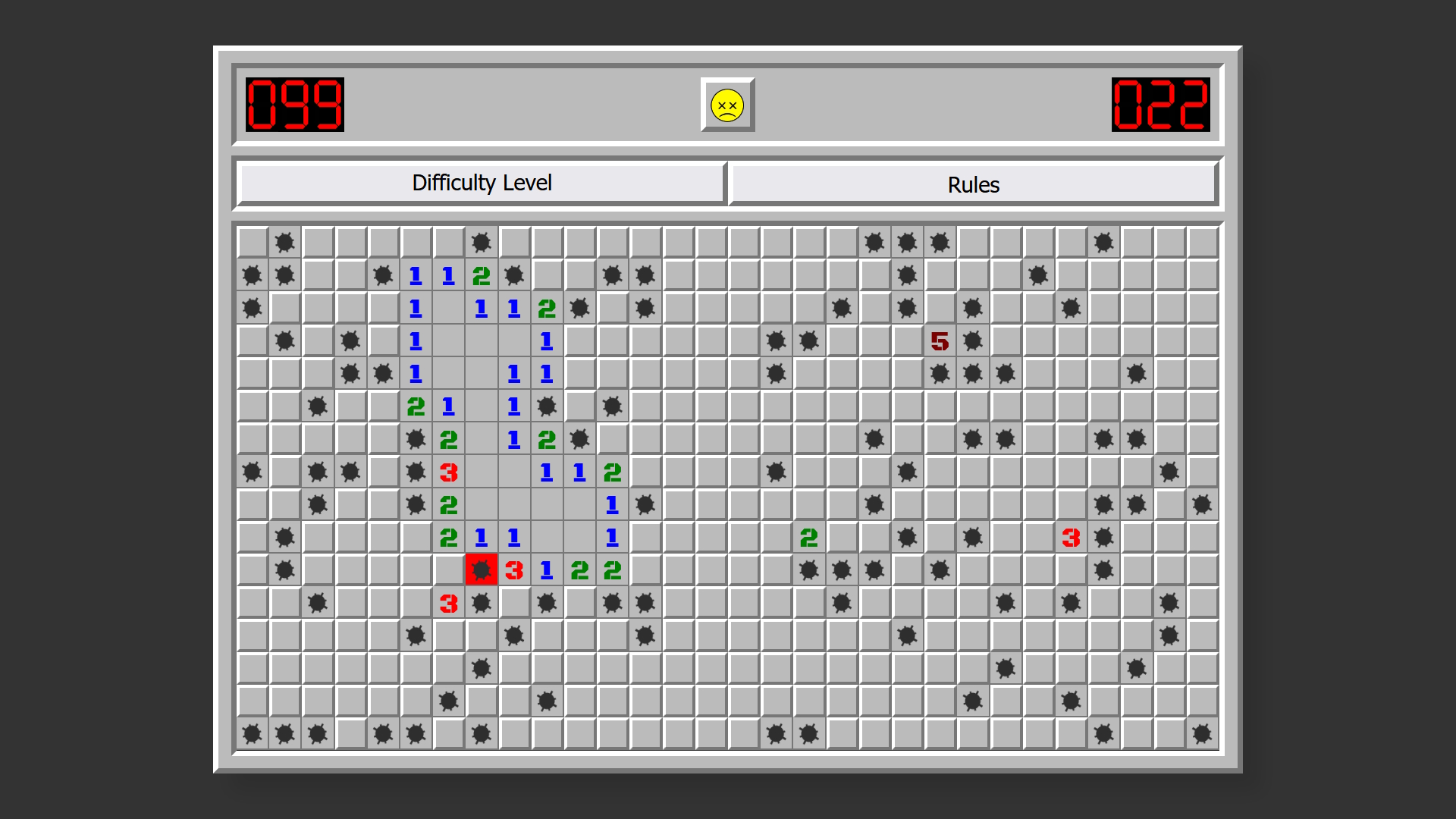
This is a classic take on that timeless logic puzzle, complete with the familiar retro look—a gray grid of raised tiles, a smiley-face reset button, and digital counters. The aim is simple: clear the entire board without detonating a mine. Here's a detailed look at how it works:
The Goal of the Game
Reveal every cell that doesn't contain a mine, and flag every cell that does.

The Board
The board is a grid of square cells that hide either mines or numbers. You can pick a preset difficulty (Beginner, Intermediate, or Expert) using the Difficulty Level button, or check the Rules button for a quick refresher.
The Rules

1. Starting the game
Your first click on any cell is guaranteed to be safe—it will never hit a mine.
2. Opening a cell
If there's no mine under a cell, it opens and shows a number indicating how many mines are in the eight surrounding cells (above, below, left, right, and the four diagonals). The numbers are color-coded—1 is blue, 2 is green, 3 is red, and so on—to make them easy to read. If there is a mine under the cell, the game ends and every mine on the board is revealed.
3. Flagging a mine
You can place a flag on a cell if you think it hides a mine. Flags help you avoid clicking a mine by accident and keep track of how many mines remain around the open cells.
4. Auto-opening neighbors
If a numbered cell already has the right number of flags around it, you can click that cell again (or click the left and right mouse buttons together) to automatically open all of its unflagged neighbors. This speeds up play.
Ending the Game
- You win when every mine-free cell is open and all mines are flagged.
- You lose the moment you open a cell containing a mine.
The Google Minesweeper Interface
- The playing field is a grid of raised gray cells.
- Mine counter. The digital counter on the left shows how many mines are left to find (it drops by one for every flag you place).
- Timer. The digital counter on the right tracks how long you've been playing.
- Smiley reset button. The smiley face in the center starts a fresh game—click it any time to restart, even mid-session.
- Difficulty Level. Lets you switch between Beginner, Intermediate, and Expert boards.
- Rules. Opens a short reminder of how to play.

Strategy
- Start in the corners or along the edges—the odds of hitting a mine are slightly lower there.
- Pay attention to the numbers; they tell you how many mines are nearby.
- Use flags to mark the cells you believe hide mines.
- Analyze number combinations. For example, if a cell shows "1" and has only one unopened neighbor, that neighbor almost certainly holds a mine.
- Use elimination. Once you've found all the mines around a numbered cell, its remaining neighbors are safe to open.
- Be careful—one wrong move can end the game.
Extra Features of Google Minesweeper
- Plays right in your web browser—no download or installation needed.
- Multiple difficulty levels: Beginner, Intermediate, and Expert.
- The familiar, easy-to-read classic interface with color-coded numbers.
- A handy Rules button if you ever need a quick refresher.
- Works on both computers and mobile devices.
Summary
Google Minesweeper is a great game for sharpening your logical thinking and attention to detail. It's easy to learn but rewards a strategic approach. Good luck out there in the minefield!